Showing posts with label London. Show all posts

Monday, June 29, 2009

Martinec’s hyper-realism returns to NPG


London based Czech artist, Hynek Martinec, (born 1980) has at 28 not only completed the Academy of Fine Arts (AVU) in Prague, but after having worked in New York (amongst others attended Jeff Koons’ studio ), Paris and London, also managed to win the prestigious BP Young Artist Award at London’s National Portrait Gallery (NPG) in 2007. His work is to be found in many other respected public and private collections, notably including the British Museum’s collection of Prints and Drawings.

Martinec’s work oscillates between the abstract (as for example in ‘The Cables’ series from 2006-7) and classical figurative painting, with the latter being frequently reminiscent of the Old Masters (as in the ‘Lost in Time’ series from 2008). Awareness of his work has undoubtedly been significantly widened by his hyper-realistic portrait of his girlfriend ‘Zuzana in Paris studio’, for which he received the aforementioned prize in 2007. Two years later, Martinec was selected for BP Portrait Award again, and currently until the 20th September 2009 we can see his work depicting a Sri Lankan girl Angela (2008) at the NPG.
The connecting link between very different ways of working and apparently unrelated subjects is the theme of Time. Martinec has explored this concept with the use of varying perspectives, and by drawing on a diverse range of media. His most recent project also deals with the ephemerality of the moment . Entitled ‘At the Same Time…’ it captures the same instant in different locations. A number of canvasses from this series are to be exhibited at the 4th Prague Biennial.


Published in Flash Art, Vol. III No 11-12, March - May 2009 (http://www.flashartonline.com/)

Thursday, May 14, 2009

Revealing rituals & taboos

The Czech artist, Tereza Bušková (born 1978), completed her MA in 2007 at the Royal College of Art in London, where she concentrated mainly on printmaking and short experimental film. She attained acclaim early with her first film ‘Wedding Rituals’ (2007) at the Pärnu International Film & Video Festival in Estonia in the same year, and then again in Canada at the AGH's 10th International Film & Video Festival in 2008. In this and in her next film, ‘Forgotten Marriage’ (2008), she has examined the roles and hidden meanings of traditional rituals. These are presented to the viewer as poetic events, while nonetheless retaining much in terms of dark sexual connotations, thereby evoking questions regarding primeval gender roles. The stories are presented without a narrative framework, which enables the author to work very loosely with visual, and often almost theatrical effects reminiscent of Tableaux Vivants. Tereza Bušková’s films encourage a multilayered interpretation, and her setting up of these different yet parallel layers of meaning makes for very compelling viewing. Bušková’s most recent project, entitled ‘Spring Equinox’ has gained the support of the British Arts Council, and is to be exhibited from 9 July until 16 August 2009 in Anita Zabludowicz’s 176 Gallery in London.


Published in Flash Art, Vol. III No 11-12, March - May 2009 (http://www.flashartonline.com/)

Monday, December 1, 2008

The Saatchi Gallery in Chelsea

The eagerly anticipated opening of the new Saatchi Gallery finally took place at the beginning of October 2008 in Chelsea, London. The gallery, with its generous exhibition space of 70,000 sq ft is already the third in which world-renowned collector Charles Saatchi has displayed his collections of contemporary art.

In 1985, he opened his first gallery in the space that had previously housed a paint factory in St John’s Wood, North London. The core of the collection at that time was mainly comprised of a selection of the work of American artists; Donald Judd, Brice Marden, Richard Serra and Cindy Sherman among others. His exhibition of Cy Twombly for example, the artist’s first in Britain, is testament to the fact that Saatchi has repeatedly anticipated the times and the trends followed by institutions. In the early nineties, the collector turned his attention from American to British artists. It is undeniable that Saatchi stands at the beginning of the phenomenally successful career of Damien Hirst as well as the rest of the generation known as the Young British Artists (YBAs). Indeed it was with a retrospective exhibition of these artists’ work that he opened his new gallery in County Hall (the Greater London Council's former headquarters) on the South Bank of the Thames in 2003. The gallery was forced to move a mere two years later however, due to an unsuccessful legal battle with the owners of the space.
Saatchi’s new gallery in Duke of York's HQ on the King's Road opens with the exhibition “The Revolution Continues: New Art from China”. In thirteen halls it presents twenty four Chinese artists; all of whose works are from among the collector’s private acquisitions. These naturally include the names of the latest stars of the Chinese art world, like Zhang Xiaogang and Fang Lijun, also currently exhibiting in the Rudolfinum Gallery in Prague. Much of the heat is on artistic pair Sun Yuan and Peng Yu. On the ground floor these artists present us with 13 incredibly lifelike figures of old men wheeling about on wheelchairs, all uncannily reminiscent of world dictators from recent history. The wheelchairs move around apparently aimlessly in various directions, resulting them to repeatedly collide before moving on in different directions.

To summarise the nature of this exhibition (which in a few months, will be replaced by one of art from the Middle East) we can highlight the following: in the majority of cases we’re dealing with figurative artworks, ones that often carry a strong political or social message; the quality fluctuates (the presence of a weaker work sometimes surprises one by sticking out amongst the masterpieces); the sculpture represented has more in terms of innovation and imaginative creation than the paintings, which in some cases betray an almost forced attempt to consciously define themselves against the established western corpus that has so clearly influenced them. The transfer of the gallery to a wealthy area, and the firm place the Saatchi label now holds on the ‘map’ of the gallery establishment has perhaps inevitably led to a lessening of its onetime status as a benchmark of controversy. To seek here for the Saatchi of the 90’s would indeed be a futile undertaking.
Published in Art & Antiques, November 2008 (http://www.artantiques.cz/)

Monday, October 6, 2008

The Serpentine Pavilion

The Serpentine Gallery’s so-called ‘summer pavilion’ can be seen for a mere three months; from July 20th until October 19th in London’s Kensington Gardens. The contrast between the gallery’s sleek classicist building and the chaotic form of the neighbouring temporary structure is so striking that it gives the impression that this new construction in front of the Serpentine Gallery is the latest victim of a sweeping Hurricane, that has left only a heap of wood, glass, and a few massive beams in its wake. In jest, this is how the most recent, and in fact the only project realized in England by famous architect Frank Gehry might be described.
Gehry, working together with his son Samuel for the first time on this project, described the design of the pavilion as being inspired by Leonardo da Vinci’s drawings of siege engines. Gehry has transformed Leonardo’s giant catapult into a structure of massive wooden blocks, seemingly randomly inclined, which connect to other wooden supports. Together with the glass panels, these create rectangular planes, reminiscent of stylized butterflies’ wings that form the roof of this dramatic space. The open plan structure complete with elevated auditorium remotely resembles an amphitheatre, perfectly fulfilling its function as a site for lectures, projections and performances of all kinds.
Even before the opening of the pavilion itself, the British media had expressed surprise that this world-renowned architect and designer of the Guggenheim Museum in Bilbao and the ‘Dancing House’ in Prague had not yet built anything in England. Previously, the only example of his work in Britain was the somewhat atypical ‘Maggie’s Centre’ building in Dundee, Scotland. Could it be that in certain cases, the United Kingdom is unwilling to be open to new and inventive architecture? British conservatism is indeed a worthy topic of debate; several recent contemporary buildings might be classed as illustrations of Vitruvius’ ‘Ten Books on Architecture’. This is exemplified by John Simpson’s Queen’s Gallery (2002) built in a Doric, or more precisely Neo-Doric, style.
This could be one of the reasons why the Serpentine Gallery, having beforehand only exhibited contemporary art, came up with the idea in 2000 to embark upon a series of annual commissions by world famous architects to build temporary pavilions in front of the gallery, presenting the public with ongoing examples of contemporary architecture. One interesting condition still governs the selection: the author of the project should not have previously realized any building in England. In recent years, architects chosen have included Rem Koolhaas, Oscar Niemeyer, Daniel Libeskind and Zaha Hadid. The prestigious commission takes place every year in cooperation with the engineering firm ARUP.

Photo: Martin Horáček
Published in Art & Antiques, September 2008 (http://www.artantiques.cz/)

Thursday, May 15, 2008

Visitors Tripping in the Tate

A Colombian artist, a seemingly immeasurably deep abyss in the floor, 15 injured visitors and 4 complaints about the Tate Gallery; all in the first seven weeks of the most recent installation in the Turbine Hall at Tate Modern.
Every year, the prestigious London art gallery chooses an artist to create an installation in the vast space of its ground floor Turbine Hall. In recent years giant spiders, a mystical rising sun and giant slides have astonished visitors. This year, it’s a hole! Or rather a chasm in the floor, 550 feet long, a foot wide in places and of unknown depth.

It all starts very innocently on the eastern side of the hall with a tiny hairline fissure in the floor which, at first winding and threadlike, soon increases dramatically in size and depth, at times branching off into lightning-like offshoots, before disappearing again on the other side of the hall; like a crevasse gaping dangerously in the earth’s surface. Everything appears perfectly organic and naturally, and the illusion that only moments ago an immense tremor shook the structure of the mighty building and split open the floor is perfect, as the contours of the right hand side of the crack closely follow those on the left, in essence creating two complementary ‘positive’ and ‘negative’ areas; a convex side and a concave side respectively. The longer this perfectly formed fissure is observed, the more questions come to mind, inevitably leading to the impression that it would have been impossible to create something like this artificially, and to the illusory belief that one has in fact, just been witness to the effects of real and devastating passing seismic activity in the interior of the Tate gallery. How the artwork was actually created remains shrouded in secrecy.

The exhibited artwork carries the unusual name ‘Shibboleth’ and its creator is sculptor Doris Salcedo from Bogotá (born ibid. in 1958). Salcedo is not only the first non-European or North American artist to be invited to exhibit an installation at the Tate, but as opposed to previous installations, her work also carries a strong political message. The name ‘Shibboleth’ (or password) alludes to the Old Testament story from the book of Judges, where enemies were revealed by their inability to pronounce the word ‘shibboleth’. Those unable to articulate the term correctly due to differences in dialect were executed.

Therefore Salcedo brings to our attention that similar discriminatory practices continue in today’s society. The West is eager to present its period of racism and colonisation as ancient history, yet in our nominally ‘post-colonial’ age, those who are not of the ‘chosen people’ still experience this as a harsh reality. If you don’t speak the required ‘passwords’ with the correct pronunciation, some doors will remain forever closed to you, and naïve attempts to cross to the other side will leave you in a bottomless crevasse.

London is Europe’s most cosmopolitan metropolis, and this immediately begs the question as to whether the artist’s message is well placed here. Indeed it doesn’t seem to be at first sight, yet as with the barely visible hairline crack with which the artwork begins, the more one investigates and the longer one tarries in London and gets acquainted with the rhythms of the city, the more this gap widens and the deeper it seems to grow. The divide no longer merely consists of nationality or accent; factors such as where one lives, goes shopping, or spends one’s leisure time, all play a subtle but fundamentally divisive role. People living in the wealthy areas of West London rarely venture to the East End and vice versa. These are in many ways distinct communities, small islands separated by a great chasm.
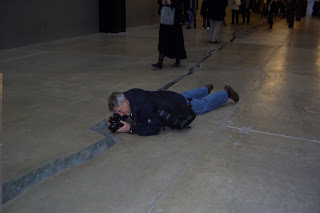
Salcedo’s work is very visually powerful, and carries a strong social message. I remain a little concerned however as to whether the visitors’ attentions are not overly occupied with discovering the origin of the apparent seismological wonder or with the anxiety of avoiding damage to their expensive footwear to give much thought to any questions of class inequalities in their society. Perhaps at least those who were injured gave the work some thought, enough at any rate to have got themselves lodged in it. Paradoxically though this does not seem to have brought them to any greater altruism, but rather to lodging complaints about the gallery.

Turbine Hall, Tate Modern; 9 October 2007 - 6 April 2008
Published in Art & Antiques, January 2008 (http://www.artantiques.cz/)
Photo: Tomas Rabl, Veronika Wolf